
Get the Skills To Advance Your Massage Therapy Career
Get the Skills To Advance Your Massage Therapy Career
Welcome to National Holistic Institute! Get hands-on instruction at 10 California campuses.
We are a massage school dedicated to training professional massage therapists. From enrollment to graduation and beyond, you are joining a supportive holistic community dedicated to your success!
Students & Employers Love Us!

The Associates of Applied Science (AAS) Degree program has opened so many doors for me in the massage therapy business. I see that more patients are looking for neuromuscular massage therapists. When I explain what I do and what I can do for them, all patients request my massage therapy, which opens up so many different opportunities for me! I’m so glad I went on and took the ANMT and AAS Degree Programs!!! Thank you NHI!
Marti Mendiola | Modesto Campus

NHI has changed my personal life completely. I have met people who are generous, kind, educated and have goals in their lives. That has helped me in my life because today, I can see that whatever you set your mind to and pursue can be done. NHI helped me open doors to make my own business doing what I love most.
Zulma Portillo Martinez | Sacramento Campus

Deciding to go to NHI to learn massage therapy and start my own private practice was one of the best decisions I have ever made in my life. After checking out several other massage therapy schools, there was no comparison to the energy and enthusiasm I saw and felt in the NHI classroom. I owe NHI everything! I have never been happier creating a life for myself doing massage therapy.
Reggie Reaves | Emeryville Campus

NHI is a place where everyone is able to show up as their best and highest self and unapologetically come and be as they are. I found the environment to be accepting, compassionate and full of very passionate, knowledgeable staff. NHI provided me with many tools to help me better care for people on a much more deep and profound level with the holistic approach in the Core Massage Therapy Program. I went on to complete the Advanced Neuromuscular Therapy (ANMT) Program which gave me the ability to work smarter instead of harder.
Brittany “Shon” Anderson | Studio City Campus

The training and education I received at NHI was very thorough and I enjoyed the structure of the classes. They include the history of massage modalities in their program. It was easy to do part time while working full time. I wouldn’t have a career without NHI. NHI really helped me find something I’m passionate about and want to carry with me forever!
Blossom Neidenbach | Santa Rosa Campus
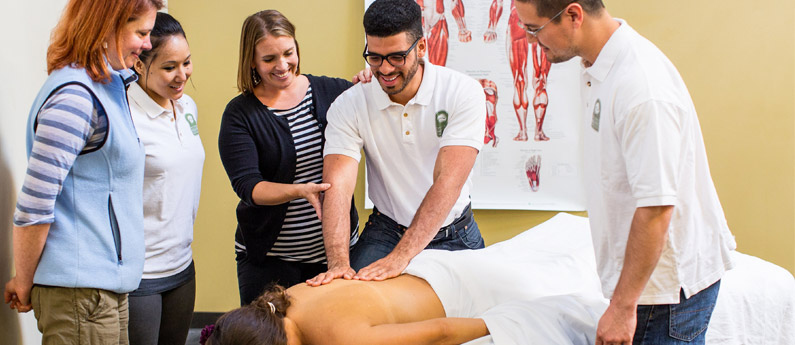
Provide Deeper Benefits to Clients Through Neuromuscular Therapy Continuing Education
As a Neuromuscular Therapist you will be able to provide effective and safe patient centered manual therapies. You will learn to work in collaboration with other health care professionals.
Advance Your Career With Advanced Education
Our Advanced Neuromuscular Therapy Program is a stand-alone continuing education program for massage therapists and other health care professionals. Our program is the most comprehensive continuing education program in the nation and is the only continuing education program for bodywork in the country that is accredited by the Department of Education.
The Advanced Neuromuscular Therapy (ANMT) Program consists of 5 Modules, each of which focuses in detail on one area of the body:
- Shoulder Thoracic
- Head & Neck
- Lumbar Pelvic
- Lower Extremities
- Upper Extremities
The ANMT Program is taught in an interactive distance learning format. During each module, students experience a dynamic learning environment through:
- 15 Academic classes online via Microsoft Teams
- 5 on campus manual therapy classes
- Support materials include:
- Daily review quizzes
- Manual Therapy instruction videos featuring ANMT Program Founder Cynthia Ribeiro
If you completed a massage therapy education of at least 500-Hours and/or are a licensed health care professional, completion of the Advanced Neuromuscular Therapy Program will allow you to:
- Set yourself apart with an understanding of the bio-psycho-social theory of pain
- Confidently apply a non-pharmacalogical approach to pain management
- Achieve the confidence to communicate and collaborate with other healthcare professionals
- Be part of the solution to the opioid crisis by gaining experience with detailed assessment and neuromuscular techniques for persistent pain and injury rehabilitation
- Increase your freedom and opportunity to work in any environment from spas, to chiropractic offices and physical therapy studios, to building your dream private practice
If you are a Physical Therapist Assistant, Athletic Trainer, Physical Therapist, Chiropractor, Doctor, Nurse or other healthcare professional who frequently helps patients rehabilitate from pain and injury, this program will allow you to:
- Add depth and dimension to your ability to facilitate healing in your patients
Tuition & Financial Aid
You can afford to go to NHI!
Our Financial Aid Advisors are ready to help you through the massage school tuition and application process. National Holistic Institute awards financial aid to all eligible students with the vast majority receiving an individually tailored financial aid package.
Our goal is to simplify the financial aid process and to educate students on their rights and responsibilities with their finances. We strongly value and encourage financial literacy for our students by providing support for any questions you may have funding your massage therapy education.
NHI is one of the few massage therapist schools in California that qualifies for Federal Financial Aid Programs, including:
- Federal Pell Grants
- Federal Stafford Loans
- Federal Parent Loans for Undergraduate Students (PLUS)
- Federal Work Study (FWS)
- Federal Supplemental Education Opportunity Grant (SEOG)
NHI also offers additional funding options, including:
- Interest-Free Payment Plans
- Sallie Mae Smart Option Loan
Visit www.salliemae.com for more information.
Use NHI School Code 025423 when prompted.
You are strongly encouraged to complete your FAFSA prior to applying for this loan. - GI Bill®/Veteran’s Assistance Grants
For more information, and to determine if you qualify, please visit www.gibill.va.gov
GI Bill® is a registered trademark of the U.S. Department of Veterans Affairs (VA)
Advanced Neuromuscular Therapy Program

450 Hours*
Total Hours to Complete

As little as 5.5 months
Program Length

$10,943.00
Tuition
+$100 Registration Fee | +$407 Books & Supplies | +$95 Software Fee
NOTE | Participation in our program requires a digital device. You can include one in your tuition for $850, however it is optional. Alternatively, you can use your own device, as long as it meets our requirements.
*Prerequisites required. Students must complete NHI’s Core Massage Therapy Program or qualify through transfer credit evaluation before enrolling in the Advanced Neuromuscular Therapy Program.

Virtual Cadaver Experience
Virtual Cadaver Lab experience has been described by students as extremely eye opening. Seeing the body in a three dimensional sense allows them to have a much firmer understanding of muscles in relationship to surrounding structures such as the organs and the skeletal system they envelop. This approach to learning about the body is highly engaging for our students. They get to actually see the layers of muscles and the relationship of connective tissues layers within the body
Obtain Approved CEUs
The Advanced Neuromuscular Therapy Program qualifies to meet Continuing Education requirements for:
- NCBTMB Board Certified
- PT Assistants
- Personal Trainers
- Yoga Practitioners
- Pilates Instructors

Convenient Schedules
We know the demands our working professional students face. We’ve designed the advanced program to fit the needs of busy adult learners. The Advanced Neuromuscular Therapy Program is offered in five 90-hour modules, which can be taken separately or consecutively in a hybrid learning environment with classes online and on-campus. The five modules are broken up to focus on the following areas:
- Shoulder & Thoracic Region
- Head & Neck
- Lumbar-Pelvic Region
- Lower Extremities
- Upper Extremities
We wholeheartedly believe that being a well-trained massage therapist gives you the ability to improve your life, career and community in ways that will make you and the people around you happier and more fulfilled.
Take your skills and your career to the next level with Advanced Training.
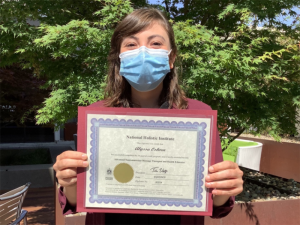
If you’re interested in going to NHI or pursuing a career in massage therapy, do it ! Don’t only join for the Core Massage Therapy Training Program, take the Advanced Neuromuscular Therapy Program and help define what Massage Therapy truly is. I went from working 60-80 hours a week in restaurants and customer service based jobs that were draining me and not allowing me to have a life. Being a Certified Neuromuscular Massage Therapist or just a CMT (Certified Massage Therapist) in general allows me to work half that amount of hours a week or less and still make a living. I am more in-tuned with my own body and self care. I finally see a bright future for myself and am looking forward to this journey that has only just begun. Attending the National Holistic Institute has helped change my life in all the best ways possible.
Alyssa Osborn | San Jose Campus
Accreditations

Accreditation is the process of evaluating a school or educational training program to determine whether it meets standards set up by an accrediting organization. When you attend an accredited institution, you are attending a school that has undergone a rigorous process that evaluates educational quality. It’s not easy to become or remain an accredited institution. The rules and regulations are strict, precise and designed to protect students. Here are some of the benefits:
- A reliable indicator of quality
- Approved program of study
- Qualified instructors
- Recognition by employers nationwide
Is A Rewarding Career In Massage Therapy Right For You? Get More Information…
If you’re interested in learning more about careers in Massage Therapy and exploring whether NHI is right for you, fill out the form on this page and receive more information.
A helpful NHI Admissions Representative would be happy to answer any questions you have and help with everything from scheduling to financial aid.